


Middle East Conflict Australian Freight Update — 7 April 2026
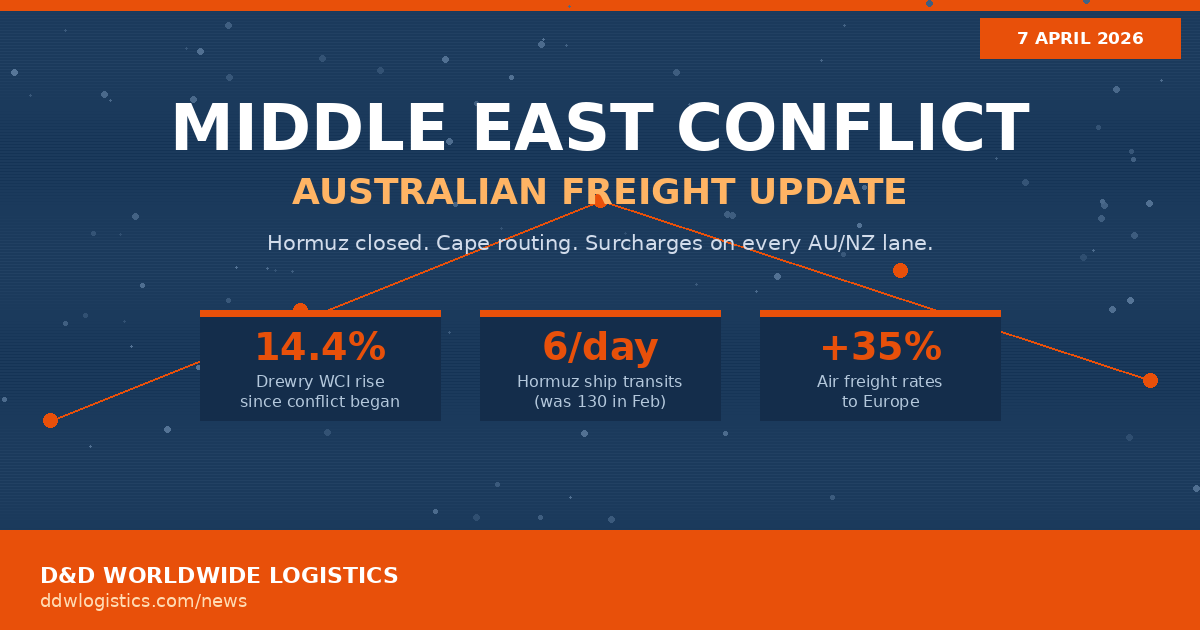
STATUS — 7 April 2026: Hormuz effectively closed. Cape of Good Hope routing on all lanes. EFS/EBS is active across all 15+ carriers on all Australian and New Zealand trades. Trump's deadline to Iran expires tonight. No ceasefire agreed.
We closed the office for Easter on Friday. The conflict didn't. Six weeks in, the situation has escalated further, and the freight impact on Australia is getting worse, not better. This update covers everything that has changed since our last briefing and what it means for your business right now.
Where Things Stand Right Now
Let's start with the elephant in the room.
Trump set a deadline of 8 pm EST tonight for Iran to reopen the Strait of Hormuz. If it doesn't, he has threatened strikes on Iranian power plants and bridges. Iran has rejected the 45-day temporary ceasefire that regional mediators were pushing over the weekend, and says it won't reopen Hormuz unless there is a permanent end to the war with guarantees it won't be attacked again. Pakistan has put forward a two-phase peace framework — the so-called Islamabad Accord — and Iran is reviewing it, but hasn't accepted it. As of this morning, the two sides are still a long way apart.
On Monday, Israel struck the South Pars Petrochemical Plant in southern Iran. That one facility accounts for roughly 50% of Iran's petrochemical production. The strike matters for freight because it adds another layer of uncertainty over Gulf energy and chemical supply chains, which flow directly into Australian import costs for plastics, fertilisers, and industrial inputs.
Meanwhile, ship transits through the Strait dropped from approximately 130 per day in February to just 6 in March, according to a UN report released this week. The strait is, for practical purposes, closed to commercial shipping.
Even a Ceasefire Won't Fix This Overnight
I want to be straight with you on this: even if a ceasefire is agreed tonight, the freight market does not bounce back immediately. Eurasia Group published an analysis this week confirming that it would take at least two months for shipping companies to resume normal tanker operations through Hormuz, and several months beyond that to repair the energy infrastructure that's been damaged in the Gulf. The backlog of vessels, cargo and equipment that has built up over six weeks does not clear quickly.
Xeneta's chief analyst said publicly that plans for any phased return to the Red Sea or Suez Canal in 2026 have been shelved. Cape of Good Hope routing is where we are, and it's where we're staying for the foreseeable future — ceasefire or not.
What that means practically: add 10 to 14 days to all transit times on Australia–Europe, Australia–UK, Australia–Middle East, and Australia–Indian Subcontinent lanes. Those extra weeks are not going away any time soon.
What the Carriers Have Done Since Easter
The surcharge stacking that we warned about before Easter has arrived. Here is what landed on 1 April and what is coming on 16 April.
MSC implemented a rate restoration of USD $300 per TEU from North and Southeast Asia to Australia and New Zealand. ANL — CMA CGM's Australian brand — applied a USD $300 rate restoration on 20-foot containers and USD $600 on 40-foot containers from Asia, the Indian Subcontinent, and the Middle East, layered on top of existing spot rates. Evergreen's EBS also kicked in on 1 April. PIL confirmed their EBS of USD $80 per TEU for dry cargo, reviewed monthly. OOCL are reviewing their EBS every two weeks. Hapag-Lloyd's War Risk Surcharge of USD $1,500 to $3,500 per TEU remains in place. Maersk's Emergency Bunker Surcharge is still in effect and is reviewed every 14 days.
Then there's the ANL General Rate Increase that hits on 16 April. This one is specifically targeted at northern Australian ports — Gladstone, Townsville, Darwin, Dampier, Port Hedland — as well as PNG, Solomon Islands and Vanuatu services. It's USD $350 per TEU and USD $700 per FEU. If you're shipping to or from any of those ports, you need to know about this now, not after your next shipment is booked.
The Drewry World Container Index has climbed 14.4% since the conflict escalated and is sitting at around USD $2,172 per 40-foot container. Budget assumptions made in late 2025 are now well out of date. If your freight budget hasn't been reviewed since February, it needs to be.
Australian Agriculture and Food Exports — This Is Getting Serious
Food freight is what we specialise in, so I want to spend some time on this because the impact on Australian agriculture is significant, and it's not getting enough attention.
Australian red meat and livestock exports to the Middle East and North Africa hit a record $2.2 billion last year. Exporters on those lanes are now looking at emergency conflict surcharges, war risk surcharges and deviation charges of up to USD $4,000 per container — and in some cases, carriers are imposing these after cargo has already been accepted. That's not a small cost. For high-volume traders, these are unplanned hits running into hundreds of thousands of dollars.
Dairy is being hit hard, too. Australian dairy exporters are reporting international freight cost increases of up to 50%. The Australian Dairy Products Federation has said the disruption is now affecting product integrity and shelf life — not just the cost of getting product to market. When your freight takes two weeks longer to arrive, chilled and fresh product suffers.
Lamb and citrus shipments to the UK are at spoilage risk because of extended Cape routing. Some exporters are already shifting to East Coast North American gateways just to keep product moving. That adds cost and complexity, but on some lanes, it is the better option right now.
On the import side, fertiliser is the one to watch. Australia imports a significant volume of fertiliser from the Middle East, and the spring seeding season is approaching. Fertiliser Australia has said requirements through mid-April appear covered. But if Hormuz stays closed beyond that, the pipeline gets tight fast. Fertiliser importers should be talking to us now about forward supply positions.
The VFF and Australian Dairy Farmers are both on record saying nobody comes out of this well. They're right. The question is how well prepared you are.
Air Freight — Still Badly Disrupted
Spot air freight rates to Europe are up more than 35% since the start of March, and they have not come back down. Emirates, Qatar Airways and Etihad carry 13% of all global air cargo — with Gulf hub closures, that capacity has effectively been pulled from the market. Singapore, Hong Kong and Kuala Lumpur are absorbing the overflow, but they're getting congested. If you have time-critical freight that would normally transit Dubai, Doha or Abu Dhabi, you need alternative routing sorted before you book. Call us first.
Road Freight — Diesel Is Still Punishing
The Federal Government's fuel excise cut and the elimination of the heavy vehicle road user charge took effect on 1 April. That helps a little. But diesel terminal gate prices are still running approximately 40% above where they were in late February, and road fuel levies are recalculated every single Monday. If your freight quotes look different week to week, this is why. Transport operators have no margin to absorb this — the surcharges are going on because the maths don't work without them.
Insurance — Please Do Not Skip This Section
I say this in every update, and I'll keep saying it: if your cargo touches the Middle East in any way — even just transiting through a Gulf port — check your insurance cover with your broker before it ships. Carriers and freight forwarders are not liable for war-related loss or damage under standard transport documents. That exposure is on the cargo owner. War risk premiums have surged 50 to 100% since the conflict started, and multiple P&I clubs have cancelled Gulf coverage entirely. This is not optional. Confirm your position.
One Piece of Genuinely Good News
The Australia–EU Free Trade Agreement was finalised on 24 March. Under the deal, 97.8% of Australian goods exports to Europe will enter duty-free. For food exporters and manufacturers shipping to Europe, this is a meaningful long-term win — even if the short-term freight cost picture is difficult. We're putting together a separate explainer on what the AU–EU FTA means specifically for Australian exporters. Watch this space.
What You Should Do Right Now
Here's the practical list.
• Don't rely on any rate quoted before this week. Surcharges are recalculated weekly. Nothing is confirmed until you have a written booking confirmation from us.
• Build in extra lead time. Four to five weeks on top of normal transit times for any route affected by Cape routing or Gulf disruption. If you're running just-in-time, you need to act now.
• Northern Australian port shippers — take note of the 16 April ANL GRI. Gladstone, Townsville, Darwin, Dampier, Port Hedland. Get in touch before that date.
• Food and agriculture exporters — call us. If you haven't reviewed your supply chain position since the conflict began, you need to. Routing options, surcharge structures and transit times have all changed materially.
• Fertiliser importers — don't wait. Review your forward supply pipeline now. Mid-April is the window.
• Check your insurance. Talk to your broker before any shipment that touches the Middle East.
• Watch the next 48 hours. Trump's deadline expires tonight. Whether Iran opens Hormuz, negotiations continue, or strikes escalate — each scenario has a different freight implication. We will publish a follow-up as soon as there is material news.
Our job is to make your job easier. Right now, that means helping you navigate the most complex freight environment since COVID. If you're unsure about a shipment, a route, a rate, or just need to talk it through — pick up the phone.
→ Full EFS/EBS carrier schedule — all carriers, all rates: ddwlogistics.com/news/efs-schedule
→ All Middle East conflict updates: ddwlogistics.com/news
All rates confirmed at time of booking only. No rate is fixed until written confirmation is issued by DDWL. Information current as at the time of publication and subject to change without notice.