


Middle East Ceasefire Australian Freight Update — 8 April 2026
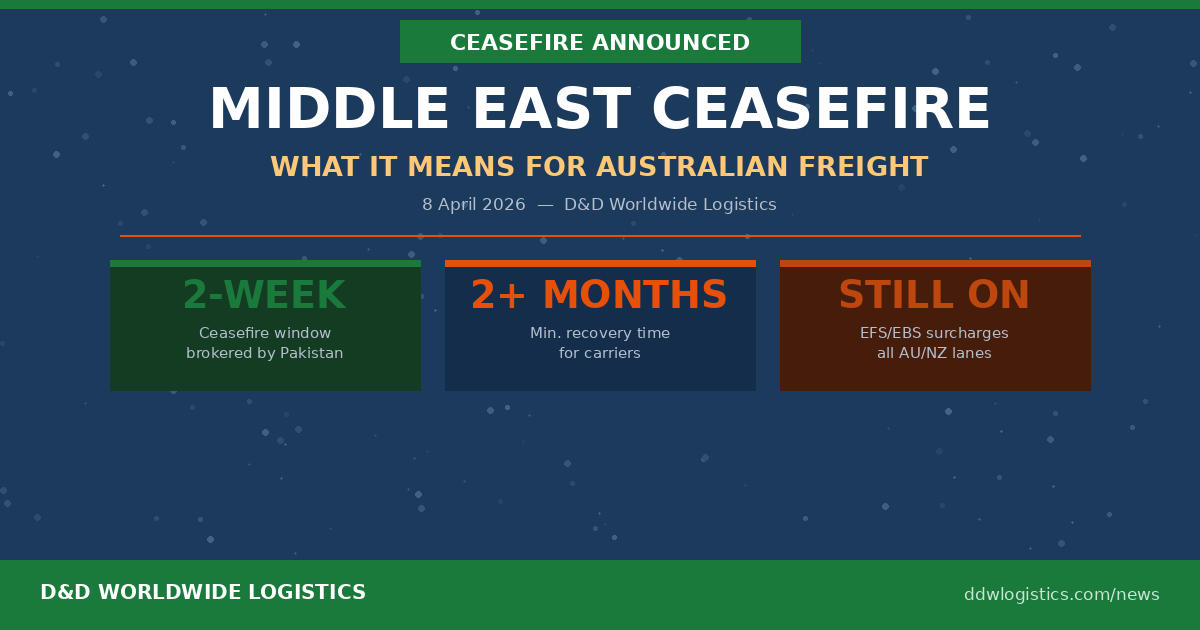
A two-week ceasefire has been announced. Hormuz opening is conditional on Iran confirming compliance. Surcharges are still active. Cape routing continues. Read this before you change anything.
Last night, right before Trump's deadline expired, Pakistan pulled off something nobody was certain was possible. A two-week ceasefire between the US and Iran was announced, contingent on Iran agreeing to the complete and immediate reopening of the Strait of Hormuz. Six weeks of conflict, the worst freight disruption since COVID, and now a pause. That is genuinely good news.
But I want to be straight with you about what it means for your freight right now, because there's a lot of noise out there and some of it will lead you to make decisions you'll regret. The ceasefire starts the clock on recovery. It does not end the disruption. Here's the full picture.
What actually happened
Hours before Trump's Tuesday night deadline, Pakistan's Prime Minister Shehbaz Sharif and Field Marshal Asim Munir brokered a last-minute framework. Trump announced on Truth Social that he agreed to suspend US bombing of Iran for two weeks, on the condition that Iran opens the Strait of Hormuz completely, immediately, and safely.
Trump called it a double-sided ceasefire and said Iran had submitted a 10-point peace proposal that he described as a workable basis for a final agreement. Almost all major points of contention have been agreed, he said. The two-week window is meant to allow a permanent deal to be finalised. Israel has also agreed to suspend its strikes. The ceasefire comes into effect when Iran opens the Strait.
As of this morning, Iran has not made a public statement confirming acceptance. Both sides are treating the framework as active. We are monitoring this closely.
The good news — and why it's not a reset button
The ceasefire is real progress. But the freight market doesn't bounce back on day one, and I think it's important you understand why, so you can plan properly.
Eurasia Group published an analysis this week confirming it will take at least two months for shipping companies to safely resume normal operations through Hormuz, even after a verified reopening. That's because tanker operators need to know the strait is genuinely safe before they route vessels back through it. Insurance underwriters won't restore Gulf coverage until they're satisfied the ceasefire holds. That process takes weeks, not hours.
Then there's the backlog. Before the conflict, around 130 ships per day were transiting Hormuz. Through March, that collapsed to just 6. Over 150 vessels are currently idling outside the strait. Getting those ships repositioned, cargo reallocated, and schedules rebuilt takes real time. And that's before you factor in the damage to Gulf energy infrastructure that analysts say will take several months to repair.
The point is this: the ceasefire changes the direction of travel. It does not change your freight budget or your transit times this week or next week. Plan accordingly.
Surcharges — nothing changes yet
I know this is the first question everyone will ask, so let me answer it directly. The surcharges are still active, and they are not going away on the back of a ceasefire announcement alone.
Carriers review EFS and EBS on a fortnightly or monthly cycle. They set those cycles based on verified market conditions, not news headlines. They will want to see Hormuz actually open, insurance markets respond, and fuel costs begin to ease before any rollback happens. That process takes at a minimum two to four weeks, and more likely six to eight weeks, before you see meaningful movement in rates.
What is still running right now: MSC's rate restoration of USD 300 per TEU from Asia to Australia and New Zealand. ANL and CMA CGM's rate restorations of USD 300 to 600 per container. The ANL General Rate Increase that hits northern Australian ports on 16 April, covering Gladstone, Townsville, Darwin, Dampier and Port Hedland at USD 350 per TEU and USD 700 per FEU. Hapag-Lloyd's War Risk Surcharge. Maersk's Emergency Bunker Surcharge. Road fuel levies are recalculated every Monday, with diesel still running approximately 40 per cent above pre-conflict levels.
Every quote you receive this week is still subject to change without notice. Nothing is locked in until you have written confirmation from us. That has not changed.
Cape routing — still where we are
No carrier is rerouting vessels back through Hormuz or Suez on day one of a ceasefire. Fleet repositioning on these runs takes weeks to plan and execute. Add 10 to 14 days to all transit time estimates on Australia to Europe, Australia to the UK, Australia to the Middle East, and Australia to the Indian Subcontinent lanes. That is still the reality on the ground today.
The one thing that may start to ease is blank sailings. As confidence builds and the vessel backlog starts to clear, carriers may reinstate some services they've been blanking. We'll be watching this weekly and letting you know as soon as that changes.
What this means for Australian food and agriculture
Food freight is what we specialise in and this is the part of the update I want to spend the most time on, because the situation for Australian producers is genuinely shifting, and there are both risks and opportunities here depending on what you export or import.
For red meat and livestock exporters shipping to the Middle East and North Africa, the ceasefire is potentially significant. Saudi Arabia, the UAE, Kuwait and other Gulf markets may start to become more accessible as the Strait opens and carrier confidence returns. But surcharges on those lanes are still active today. Don't book on the assumption that rates have dropped. They haven't yet. Call us, and we'll give you the actual current picture before you commit to anything.
For dairy exporters, the 50 per cent freight cost increase that has been hitting your margins since late February is not going away this week. Insurance terms on Gulf-adjacent routes are still elevated. Product integrity and shelf life concerns on extended Cape routing are still real. The ceasefire is the beginning of improvement, not the improvement itself.
Fresh produce exporters shipping to the UK and Europe via Cape routing are still adding two extra weeks at sea compared to normal. That isn't changing in the next fortnight. If you have perishable cargo that is time-critical, call us now about options.
Fertiliser is the category where the ceasefire could move fastest and where Australian importers need to act right now. We import significant volumes of fertiliser from the Middle East, and the spring seeding season is approaching. If Hormuz opens and fertiliser shipments resume, that supply pipeline can recover more quickly than most other cargo categories because it's bulk cargo with less complexity around routing and insurance. If you are a fertiliser importer, do not wait. Call us today, and we will review your forward supply pipeline. Timing matters here more than anywhere else.
Air freight — signs of easing
Since the conflict began, spot air freight rates to Europe have been up more than 35 percent and Gulf hub capacity from Emirates, Qatar Airways, and Etihad has been severely constrained. Those three airlines carry 13 per cent of global air cargo, and their disruption has been felt on every Australia to Europe and Australia to the Middle East air lane.
As the ceasefire takes hold, Gulf hub capacity should start to return. But airlines will come back cautiously. They will wait for airspace to be confirmed safe and for insurance cover to be restored before fully resuming routes. Expect a gradual recovery over weeks, not days. If you have urgent air freight that would normally transit Dubai, Doha or Abu Dhabi, call us before you book. We will confirm what is actually available before committing your cargo.
Insurance — update your position this week
Here is the one area where the ceasefire creates something you can actually act on right now. If you confirmed your war risk insurance position at the height of the conflict, call your broker again this week. War risk premiums should start to ease as the ceasefire holds and insurers get comfortable with the new situation. The terms you were quoted two weeks ago may no longer reflect what's available now.
And the standard reminder that I will keep putting in every update until this is fully resolved: carriers and freight forwarders are not liable for war-related loss under standard transport documents. The bill of lading and the air waybill do not protect you against war risk. That exposure sits with you as the cargo owner. Even in a ceasefire environment, confirm your cover before any shipment that touches the Middle East.
What to do this week
Here is the practical list.
• Don't dismantle your contingency planning. This is a two-week window, not a resolution. Keep your buffer stock and lead times in place until a permanent deal is confirmed and carrier conditions actually change.
• Fertiliser importers, call us today. If Hormuz opens this week, fertiliser will move fastest. Get your forward supply position reviewed now. The spring seeding window won't wait.
• Northern Australian port shippers, the ANL GRI hits 16 April. Gladstone, Townsville, Darwin, Dampier, Port Hedland. That is eight days away. Get in touch before that date if you have shipments going to or from those ports.
• Red meat and livestock exporters to Gulf markets, talk to us. Routing and surcharge conditions on those lanes are shifting. We will give you the current picture before you book anything.
• Update your insurance position. Call your broker. War risk premiums may ease. Find out where you stand before your next shipment moves.
• Keep watching rates weekly. Surcharges will not drop until carriers complete their next review cycles. We are monitoring every carrier notice and will update you as soon as conditions change.
Our job is to make your job easier. Right now, that means cutting through the noise on what this ceasefire actually means for your supply chain and what it doesn't. If you need to talk it through, pick up the phone.
Full EFS and EBS carrier schedule, all carriers, all rates: ddwlogistics.com/news/efs-schedule
All Middle East conflict updates: ddwlogistics.com/news
All rates confirmed at time of booking only. No rate is fixed until written confirmation is issued by DDWL. Information current as at the time of publication and subject to change without notice. Sources: Axios, CBS News, CNBC, Eurasia Group, Wikipedia 2026 Strait of Hormuz Crisis, FTA/APSA Australia.