


Ceasefire Is Live. Hormuz Is Not Open.
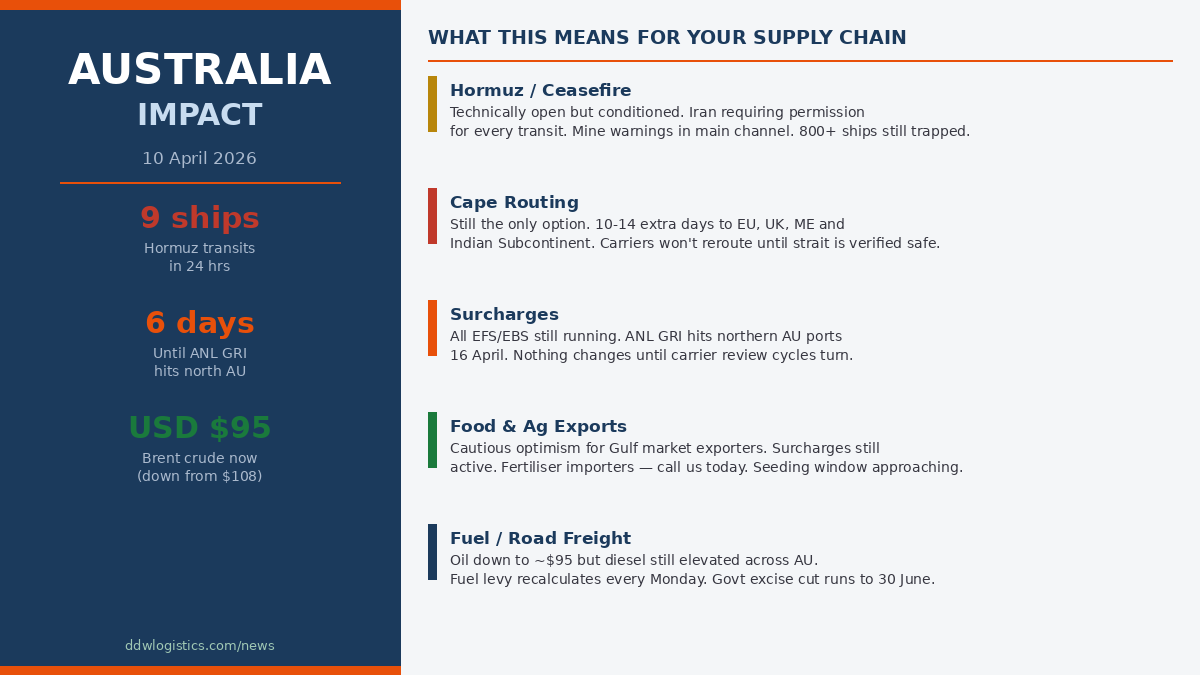
Three days since the ceasefire. Nine ships through the strait in 24 hours. Pre-war average: 100 to 120 per day. 800+ vessels are still trapped in the Persian Gulf. Iran is conditioning and controlling access. Islamabad talks are underway today. Surcharges are still active on all AU/NZ lanes. Nothing changes for your freight this week.
Three days into the ceasefire, and I want to give you a clear-eyed view of where things actually stand, not the market headlines, not the political spin, but the freight reality for Australian importers and exporters right now.
The ceasefire is real, and it is holding, just barely. Brent crude is sitting around USD 95 to 97 per barrel, down sharply from USD 108 before the deal but still well above the USD 73 it was on 27 February before the war started. Markets are cautiously optimistic. The freight market is not.
The Strait of Hormuz is not open
Let me quote the CEO of Abu Dhabi's national oil company directly, because he said it better than anyone else this week. Sultan Al Jaber of ADNOC put it plainly on Thursday: the Strait of Hormuz is not open. Access is being restricted, conditioned and controlled. That is not freedom of navigation. That is coercion.
He's right. In the first 24 hours after the ceasefire was announced, nine vessels transited the strait according to S&P Global Market Intelligence. The pre-war daily average was between 100 and 120 ships. Iran requires all vessels to seek permission from its armed forces before transiting. It has issued mine warnings in the main shipping channel and released a map redirecting ships to alternative lanes closer to the Iranian coast.
More than 800 vessels remain trapped inside the Persian Gulf. Shipping executives told CNBC this week they have no information on how to transit the strait during the ceasefire and are not in contact with Iranian authorities. The most important thing for them is the safety of their crew members, and they are waiting for guarantees before they move a single ship through.
The talks to resolve all of this are happening today in Islamabad. VP Vance, Steve Witkoff and Jared Kushner are leading the US delegation. Iran is at the table. How today goes will shape the next two weeks materially. We will update you as soon as there is news.
Lebanon is threatening to unravel everything
The biggest risk to the ceasefire right now is not Iran or the US — it is Israel and Lebanon. Israel has explicitly said the ceasefire does not cover Lebanon, where it has continued striking Hezbollah targets. Iran says it does cover Lebanon and is accusing the US of violating the deal. Australian Prime Minister Anthony Albanese joined France and other leaders this week in calling for Lebanon to be included in the agreement.
Iran has already suspended tanker traffic once in response to Israeli strikes on Lebanon, then partially restored it. This is the dynamic that is making shipping companies extremely reluctant to commit vessels to transit right now. Until the Lebanon question is resolved and the ceasefire framework is genuinely stable, the Strait will not function normally. Full stop.
What this means for Australian freight right now
Everything I said in last week's update still applies. The direction of travel is better. The freight reality on the ground has not changed yet.
Cape of Good Hope routing is still the only option for every major carrier on every lane connecting Australia to Europe, the UK, the Middle East and the Indian Subcontinent. You are still adding 10 to 14 days to transit times on those lanes. That is not changing until Hormuz is genuinely open and carriers have had time to reposition fleets and replan services. That takes weeks, minimum, even in the best-case scenario.
The ANL General Rate Increase hits northern Australian ports in six days — 16 April. Gladstone, Townsville, Darwin, Dampier, Port Hedland. USD 350 per TEU and USD 700 per FEU. If you are shipping to or from any of those ports, you need to be talking to us before that date.
One genuine piece of good news on oil. Brent crude falling from USD 108 to USD 94 to 97 is meaningful. Industry analysts have flagged that most carrier EFS and EBS surcharges were originally filed with expiry dates in mid-April and are now being reviewed and extended. The oil price drop will eventually flow through into those reviews. Eventually means two to four weeks at minimum, not this week. Keep watching your Monday fuel levy updates closely — that is where you will see the first signs of movement.
Australian agriculture and food — where things stand today
For red meat and livestock exporters to Gulf markets — Saudi Arabia, UAE, Kuwait — the ceasefire is the first credible reason for cautious optimism in six weeks. Access to those markets should improve as the Strait genuinely opens and carrier confidence returns. But surcharges on those lanes are still active right now, and Cape routing is still adding two weeks to your transit. Don't book on the assumption that conditions have improved. Call us first.
Dairy exporters are still absorbing freight cost increases of up to 50 percent. That is not changing this week. The shelf life and product integrity issues that come with extended Cape routing are still real for every UK and European shipment.
For fertiliser importers, this is the most urgent call to action in this update. The Islamabad talks today are critical. Iran's 10-point proposal explicitly includes a mechanism for controlled passage through Hormuz. If today's talks produce a stable framework, fertiliser shipments could resume meaningfully within two to three weeks. The spring seeding window does not care about geopolitics. If you have not reviewed your forward supply pipeline, do it today. Not tomorrow. Today.
Fresh produce exporters shipping to the UK and Europe — the two extra weeks at sea via Cape routing are still your reality. If you have perishable cargo approaching its tolerance limits, call us before it ships.
One category worth watching closely is fuel and diesel for Australian domestic logistics. Industry data this week shows diesel shortages are affecting around 3 to 4 percent of service stations nationally. The Federal Government's excise cut runs through 30 June 2026. What happens after that date depends entirely on how the Islamabad talks resolve over the next two weeks.
Air freight — improving slowly
Spot rates to Europe have been up over 35 percent since the conflict began. Gulf hub capacity from Emirates, Qatar Airways and Etihad has been severely constrained. The situation is improving gradually, but do not count on the rates having reset yet. Airlines are coming back cautiously. If you have urgent air freight that normally transits Dubai, Doha or Abu Dhabi, call us before you book. We will tell you what is actually available right now.
Insurance — call your broker this week
War risk premiums have been running 50 to 100 percent above normal. The ceasefire is a legitimate trigger to reassess. Call your broker this week to find out where your current policy stands and whether your terms are shifting. And the reminder that goes in every update: carriers and freight forwarders are not liable for war-related loss under standard transport documents. That exposure sits with you. Confirm your cover before anything moves that touches the Middle East.
What to do right now
• Fertiliser importers: call us today. Islamabad talks are happening now. If a stable framework emerges, fertiliser moves fastest. Review your supply pipeline immediately.
• Northern AU port shippers — 16 April ANL GRI is six days away. Gladstone, Townsville, Darwin, Dampier, Port Hedland. Get in touch before that date.
• Don't assume rates have dropped. Oil is lower, but carrier surcharge review cycles haven't turned yet. Nothing is confirmed until you have a written booking confirmation from us.
• Gulf market exporters — talk to us before you book. Red meat, livestock, and dairy to Saudi Arabia, the UAE and Kuwait. Conditions are shifting, but they haven't shifted yet.
• Update your insurance. Call your broker. Premiums may be easing. Confirm where you stand before your next shipment.
• Watch Islamabad. Whatever comes out of today's talks will shape the next two weeks of freight conditions. We will update you as soon as there is material news.
Our job is to make your job easier. Right now, that means giving you the unvarnished truth about what the ceasefire means for your freight costs and your supply chain and what it doesn't. If you need to talk it through, pick up the phone.
Full EFS and EBS carrier schedule, all carriers, all rates: ddwlogistics.com/news/efs-schedule
All Middle East conflict and ceasefire updates: ddwlogistics.com/news
All rates confirmed at time of booking only. No rate is fixed until written confirmation is issued by DDWL. Information current as at the time of publication and subject to change without notice. Sources: CNBC, NBC News, CBS News, Al Jazeera, S&P Global Market Intelligence, MarineTraffic, Kpler, FTA/APSA Australia, UN News.