


What the Middle East Conflict Actually Means for Australian Cargo Right Now
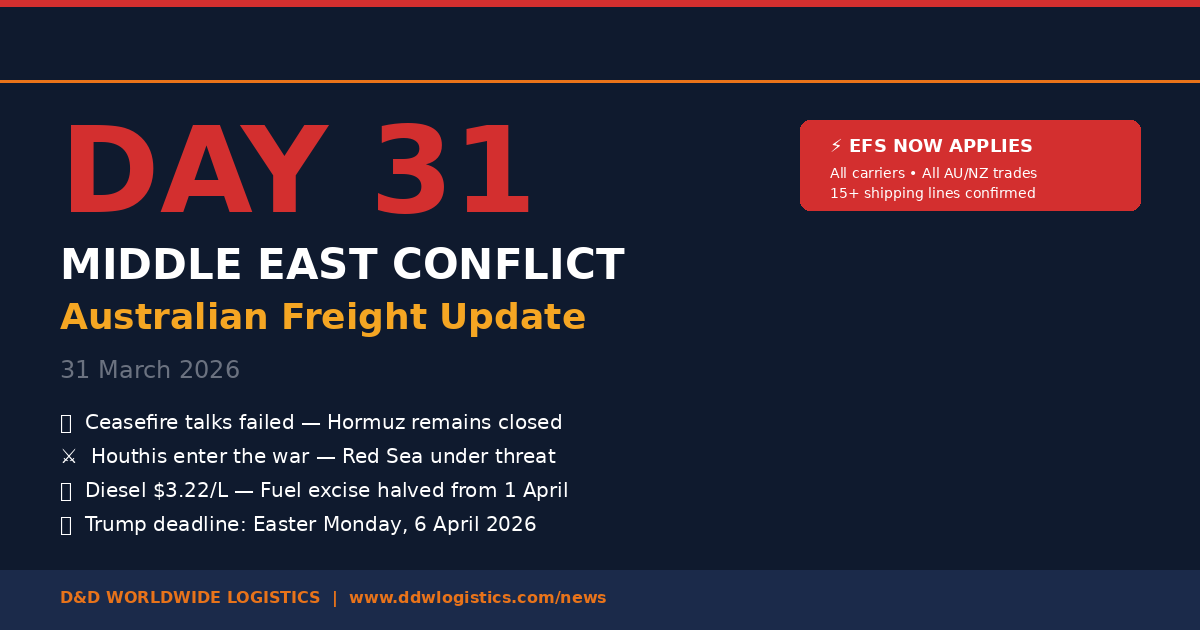
One month in. No ceasefire. The Strait of Hormuz is closed, the Red Sea is under renewed threat, and the ripple effects are now hitting Australian businesses hard — at the fuel pump, on the wharf, and across every supply chain that touches international freight.
The head of the International Energy Agency flew to Canberra last week and said publicly that what we’re going through right now is worse than the two oil shocks of the 1970s combined. The world has lost 11 million barrels of oil per day. For context, both 1970s crises together accounted for 10 million.
This isn’t theory. This is showing up in real costs, real delays, and real consequences for anyone shipping cargo into or out of Australia. Here’s where things stand.
Australia’s Fuel Crisis — The Numbers
Australia imports around 80–90% of its refined fuel. We have two refineries, Lytton in Brisbane and Viva in Geelong, and they cover roughly 20% of national demand. Both run entirely on imported crude. That makes us one of the most exposed developed nations on the planet when the global fuel supply gets disrupted.
And it has been disrupted. Badly.
• Diesel in Sydney: $3.22 per litre (NRMA, 30 March). Up nearly $1/litre in four weeks.
• Unleaded in Sydney: $2.57 per litre average. Up 98 cents from the February low.
• Diesel terminal gate prices: Up over 50% nationally since late February (Australian Institute of Petroleum data).
• Six fuel tanker shipments to Australia cancelled (confirmed by Energy Minister Chris Bowen).
• No visible fuel shipments scheduled beyond 14 April at the time of multiple independent reports last week.
• Reserves: ~39 days petrol, ~30 days diesel, ~30 days jet fuel. The government has already released 20% of diesel reserves.
• ACCC reports: Over 3,000 consumer fuel complaints in March alone. Some regional service stations have run dry.
• Brent crude: ~USD $114 per barrel. Up over 50% since the war began.
Diesel is the backbone of everything in this country. Every truck that moves your goods, every piece of farm machinery, every mine site, every backup generator. When diesel gets expensive, everything gets expensive. And right now it’s very expensive.
What the Government Is Doing
On 30 March, the Prime Minister announced a $2.55 billion National Security Plan after a 2.5-hour National Cabinet:
• Fuel excise halved from 52.6¢ to 26.3¢ per litre for three months (1 April – 30 June)
• Heavy vehicle road user charge eliminated for three months — that’s 32.4¢/litre off diesel for trucks over 4.5 tonnes GVM
• ACCC monitoring retailers to ensure savings are passed through at the bowser
• National Food Supply Chain Assessment commissioned
• Six tankers of jet fuel secured from China and other suppliers, arriving between now and 8 April
That excise cut works out to roughly $19 off a 65-litre tank. It helps. But it’s a band-aid on a bullet wound when diesel has moved nearly a dollar a litre in a month.
The IEA has separately recommended that Australia consider work-from-home mandates, carpooling incentives, lower highway speed limits, and reduced air travel. The government hasn’t gone there yet — but the fact it’s on the table tells you something about the severity.
The April 20 Problem
J.P. Morgan published a global supply shock map last week, which drew a lot of attention. It showed the wave of oil disruption spreading east to west from the Strait of Hormuz, hitting Asia first, then Africa, then Europe, then the Americas.
For Australia and the broader Asia-Pacific region, the timeline is stark. J.P. Morgan’s analysts estimate that most Gulf-origin oil deliveries to this region will stop arriving around 20 April. Southeast Asia’s oil demand is expected to drop 300,000 barrels per day in April alone. If the situation doesn’t improve, losses could exceed 2 million barrels per day by May.
The government says fuel supply is secure through mid-April. But the gap between mid-April and the next confirmed shipments is the part that should have everyone’s attention. If there’s no ceasefire and no reopening of Hormuz, that gap becomes a real problem.
What This Means for Cargo Moving Into and Out of Australia
Ocean Freight — Imports and Exports
Every major carrier is routing via the Cape of Good Hope. That adds 10–14 days on Australia–Europe, Australia–Middle East, Australia–Indian Subcontinent, and most Australia–UK lanes. There is no Suez shortcut. There is no Hormuz transit. Cape routing is the only option, and it’s going to stay that way for the foreseeable future.
Emergency Fuel Surcharges (EFS/EBS) are in force across all 15+ carriers on all Australian and New Zealand trade lanes. Not one carrier is reducing or removing surcharges. Every single shipping line servicing Australia has now implemented some form of conflict or fuel surcharge. Evergreen’s new EBS kicks in on 1 April.
For exporters: if you’re shipping Australian food products, agricultural goods, or manufactured exports to Europe, the UK, the Middle East, or the Indian Subcontinent, your transit times are materially longer and your costs are materially higher than they were five weeks ago. Factor that into your planning and your pricing.
For importers: lead times on inbound cargo have blown out. If you’re expecting containers from Europe, the UK, the Mediterranean, or anywhere that previously routed through Suez or Hormuz, add at least two weeks to your timeline. If you’re operating on just-in-time models, you’re already feeling this.
Schedule reliability has also taken a hit. Carriers are rolling containers at origin, blank sailings are increasing, and vessel availability on some lanes is getting tight heading into Q2. If you haven’t locked in your bookings, do it now.
Air Freight
Gulf hub closures are ongoing. Emirates, Etihad, and Qatar Airways are still not operating normal schedules. That means belly-hold capacity on Australia–Europe lanes is down approximately 18% — and that’s a conservative number.
Spot air freight rates to Europe are up 35%+ since 1 March. Oman Air has extended flight cancellations through mid-April. The government has secured six tankers of jet fuel from alternative suppliers, but capacity is tight, and backlogs at origin airports are building.
If you’re shipping anything time-critical by air that would normally transit through Dubai, Doha, or Abu Dhabi, you need alternative routing. Singapore, Hong Kong, and Kuala Lumpur are absorbing overflow, but they’re getting congested. Talk to us early.
Domestic Freight and Road Transport
The fuel excise cut and heavy vehicle road user charge elimination from 1 April will provide some breathing room for the road transport sector. But diesel terminal gate prices are still at record highs, and road fuel levies are recalculated every Monday.
If your freight quotes look different from a couple of weeks ago, this is why. Transport companies are passing through fuel surcharges — and they have no choice. When diesel costs this much, the maths simply doesn’t work without recovery mechanisms.
Food exporters, retailers, agricultural businesses, and anyone dependent on refrigerated transport should be factoring in higher inland costs for at least the next quarter. This isn’t going back to normal quickly.
Marine Cargo Insurance
War risk cover for the Gulf, Persian Gulf, and Gulf of Oman remains cancelled. Major P&I clubs pulled coverage in early March, and there is no indication it’s coming back.
If you have any cargo on a route that touches the Middle East — even in transit — your insurance position needs to be confirmed with your broker before you ship. Carriers and freight forwarders are not liable for war-related loss under standard transport documents. That exposure sits with the cargo owner.
This is not optional. Check your cover.
Key Dates to Watch
Date | What It Means for Your Freight |
1 April | Fuel excise halved. Heavy vehicle charge eliminated. Evergreen EBS takes effect. |
3–6 April | Easter long weekend — DDWL offices closed. Most Australian logistics operations paused. |
6 APRIL | US deadline for Iran to reopen the Strait of Hormuz. The outcome will shape the freight environment for weeks. |
7 April | DDWL offices reopen. Normal operations resume. |
~Mid-April | Last confirmed fuel shipments arriving in Australia. Gap in visibility beyond this point. |
~20 APRIL | J.P. Morgan estimate: Gulf-origin oil deliveries to Australia/Asia region stop arriving. |
Every Monday | Road fuel levies are recalculated nationally. |
What You Should Do Right Now
1. Get time-critical freight moving before Easter. If you have anything that can’t wait, book and confirm it before the close of business on Thursday, 2 April. We reopen Tuesday, 7 April, but the world won’t pause.
2. Don’t rely on last week’s rate. Surcharges are changing weekly. Every quote is subject to change without notice. No rate is confirmed until a written booking confirmation is issued by DDWL.
3. Build 4–5 weeks of extra lead time into all supply chain plans on affected routes. If you’re running tight, pull forward now.
4. Confirm your insurance. Any cargo touching Middle East routing must have marine cargo cover verified with your broker before shipment.
5. Review your inland freight costs. Fuel levies are recalculated weekly. If you haven’t had a conversation with your transport providers about surcharge mechanisms, now is the time.
6. Talk to us. If you’re unsure about a shipment, a route, a rate, or just need someone to walk you through the options, pick up the phone. Our job is to make your job easier, and right now that means helping you navigate the most complex freight environment since COVID.
Easter Office Closure
DDWL offices will be CLOSED for the Easter public holiday period:
• Good Friday: Friday, 3 April 2026
• Easter Monday: Monday, 6 April 2026
Normal operations resume Tuesday, 7 April 2026. We’ll be monitoring developments over the break and will issue an update if conditions change materially.
We’ll keep publishing these updates for as long as this situation continues. Bookmark our news page — it’s updated regularly.
→ Full EFS carrier schedule — all 15+ carriers, all rates:
www.ddwlogistics.com/news/every-shipping-line-is-now-charging-an-emergency-fuel-surcharge-on-australian-trades
→ All previous Middle East updates: www.ddwlogistics.com/news
Stay safe this Easter. Look after your people. And if you need us, we’re a phone call away.
Sources: ACCC Weekly Fuel Monitoring (27 March), NRMA Weekly Report (30 March), Australian Institute of Petroleum, PM.gov.au (National Cabinet 30 March), IEA/Fatih Birol (National Press Club Canberra 23 March), J.P. Morgan Global Research, SBS News, The Conversation, Bloomberg, Al Jazeera, OilPrice.com, Energy Minister Chris Bowen (media statements), FTA/APSA, Shipping Australia, carrier advisories.
Published 31 March 2026 by D&D Worldwide Logistics Pty Ltd. Information is current at the time of publication and subject to change without notice.