


The First Cracks
The First Cracks.
Things are still broken. But this week, for the first time since 28 February, they started to move.
It is Monday, 16 March 2026. Day 16 of the war between the United States, Israel and Iran.
Hormuz is still effectively closed to Western commercial shipping. Weekly fuel levies are live as of this morning. The Maersk 21 March deadline is five days away. None of that has changed.
But something else has changed this week. The first meaningful countermoves are on the table — and one major carrier has already started moving cargo again.
Here's what's new.
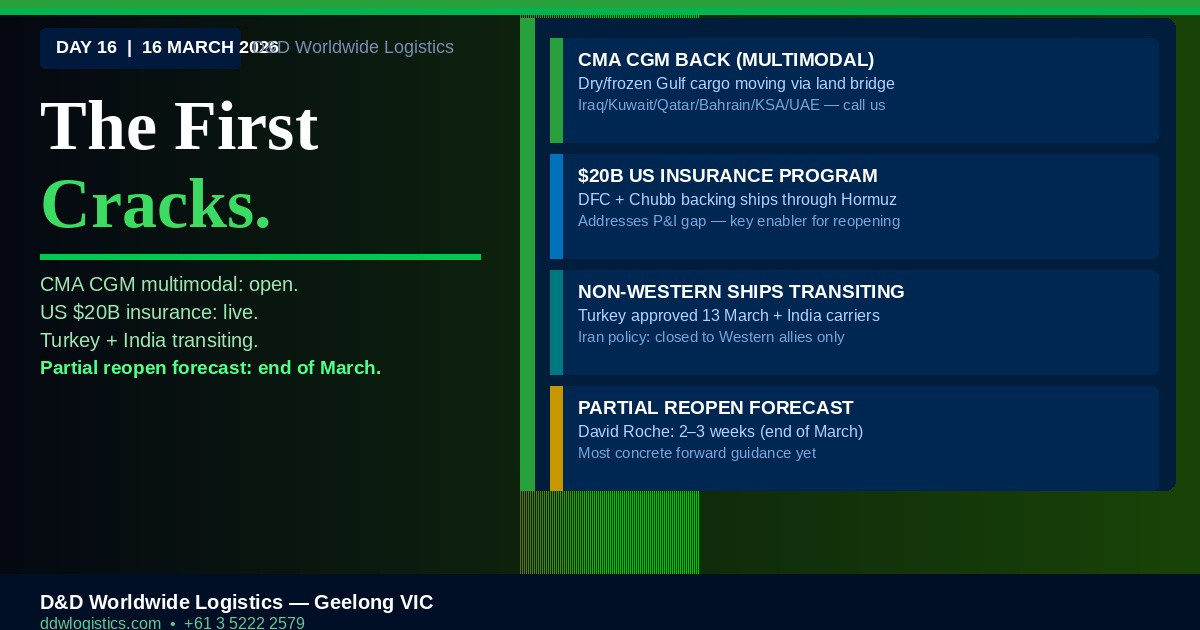
CMA CGM is back — via multimodal.
On 11 March, CMA CGM quietly reopened import and export bookings for the Gulf — not through traditional port calls, but through multimodal land bridge solutions. Cargo is being discharged at alternative gateway ports and moving by road into Iraq, Kuwait, Qatar, Bahrain, Saudi Arabia and the UAE.
This applies to dry, frozen and in-gauge cargo. Reefer, DG and OOG remain suspended. It is not a return to normal. But it is a working solution for standard cargo, and CMA CGM is the first major carrier to offer it.
If you have standard Gulf cargo that cannot wait for the strait to reopen, this is worth a conversation. Call us.
The US government has $20 billion on the table.
The US International Development Finance Corp (DFC) announced a $20 billion insurance program specifically designed to get ships transiting through the Strait of Hormuz again. Insurance giant Chubb has been appointed as the lead underwriter.
This is the missing piece that has kept ships out of the strait even when their owners were willing to try. When the P&I insurance market cancelled cover for Gulf transits on 5 March, it made the economics impossible regardless of the military situation. Government-backed cover changes that calculation.
The program provides reinsurance — Chubb provides the end insurance to shippers. Once operational alongside the US and European naval escort programmes, this creates a viable path to restarting Hormuz commercial traffic. The question is timing.
Non-Western ships are already getting through.
Iran's stated policy since 5 March has been that the strait is closed only to ships from the US, Israel and their Western allies. On 13 March, Turkey's transport minister confirmed that Iran approved the passage of a Turkish-flagged vessel. Two Indian-flagged gas carriers and a Saudi oil tanker carrying 1 million barrels for India were also permitted to pass.
This is significant in two ways. First, it confirms that selective transits are occurring — the strait is not a complete blackout. Second, it creates a growing channel for non-Western cargo. The shadow fleet (Iranian and China-linked vessels) has been making roughly half of all transits throughout the crisis.
For Australian cargo owners: this has limited direct benefit today, as Australian-origin shipments generally move on Western carriers. But it signals that a selective reopening is the most likely pathway to recovery.
An analyst says 2–3 weeks for partial reopening.
Investment strategist David Roche has publicly predicted that the Strait of Hormuz will partially reopen within two to three weeks. That puts the window at approximately the end of March to first week of April.
His reasoning: Iran's military capability has been significantly degraded (the Pentagon claims 15,000+ targets struck, missile volume down 90%), both sides have refused ceasefire talks but economic pressure is building on Iran, and the combination of US/European naval escort programmes with the new DFC insurance framework creates operational conditions for at least selective Western shipping to resume.
This is one analyst's view, not a guarantee. But it is worth knowing as you plan your April supply chain.
MSC: all Arabian Gulf shipments terminated, $800/container charge.
MSC — the world's largest shipping line — formally declared an End of Voyage for all shipments under its custody destined for Arabian Gulf ports. All affected cargo is being discharged at the next safe port and placed at customers' disposal. A mandatory surcharge of USD $800 per container applies to all affected shipments to cover deviation costs.
Critically, MSC has also invoked Clause 13 (Special Circumstances) on its Bill of Lading, meaning all discharge-related expenses — handling, storage, ancillary charges — fall on the cargo owner. If your cargo was in transit with MSC toward any Gulf port, you are liable for these costs from day one of discharge.
MSC also issued a matching End of Voyage declaration for exports from the Arabian and Persian Gulf. Both directions are affected.
Container rates up 8%. Fertiliser up 43%. The downstream is starting to show.
Drewry's World Container Index jumped 8% to US$2,123 per 40ft container in the week of 12 March — the first significant rate spike directly attributable to the Hormuz crisis.
More broadly, concerning Australian businesses: fertiliser. Roughly one-third of the global fertiliser trade transits Hormuz. Urea prices have already risen from US$475 to US$680 per metric ton — a 43% increase. With Australian farmers entering the spring planting window, this is a live cost pressure on domestic food production. The supply chain story is moving beyond shipping into agriculture.
85% of polyethylene exports from the Middle East also transit Hormuz. Packaging, automotive components and consumer goods are all facing upstream pressure.
Weekly fuel levy: live this morning.
From today, Monday, 16 March 2026, Australian road carrier fuel levies are being calculated on a weekly basis. The first official weekly levy notice has been issued for the period 16–22 March. The levy will now be recalculated every Monday and will revert to monthly calculations when diesel returns to stable levels.
GPS and AIS disruption has now affected over 1,650 vessels across the Gulf region, adding tracking and documentation complexity to all shipments moving through or around the region.
Practical guidance — Monday 16 March.
• CMA CGM reopened multimodal for dry/frozen/in-gauge Gulf cargo (dry only). Call us if this is relevant to your shipment.
• MSC End of Voyage + $800/container in effect. If you have MSC cargo en route to the Gulf, contact your MSC office immediately to confirm discharge port and recovery.
• Maersk 21 March deadline: 5 days away. Gulf cargo without instructions — call us today.
• Weekly fuel levy starts today. Check every Monday. Treat it as a variable in landed cost.
• US DFC/Chubb $20B insurance program: watch for operational date — this enables the escort corridor.
• David Roche forecast: partial Hormuz reopen possible by the end of March. Plan accordingly — don't wait for it, but don't lock in Cape routing for April if you can avoid it.
• All quotes: nothing confirmed until written booking confirmation from DDWL. Rates move every day.
📋 QUOTE DISCLAIMER All freight quotes issued by D&D Worldwide Logistics are subject to change without notice. All rates are confirmed at the time of booking only. No rate fixed until written booking confirmation is issued by DDWL. |