


Middle East Freight Update — 12 March 2026
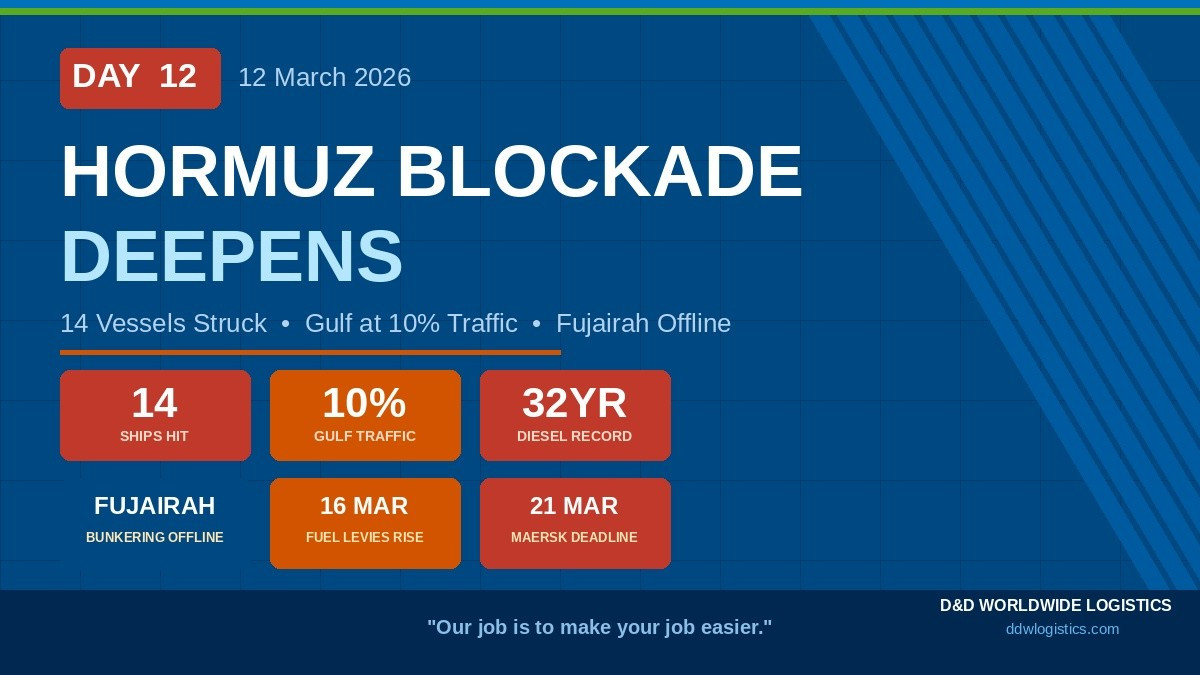
The Hormuz Blockade Deepens, Diesel Hits a 32-Year Record, and Fuel Levies Rise From Monday
⚠️ DAY 12 — SITUATION CRITICAL 14 merchant vessels have been struck in the Strait of Hormuz since 28 February. Gulf shipping traffic is at 10% of normal. Fujairah bunkering (the world's 3rd busiest) shut down entirely. US DOE/EIA diesel benchmark +96.2 cents/gallon in ONE WEEK — the largest single-week jump in 32 years. US Navy has declined shipping industry escort requests — attack risk deemed too high. Multiple road transport carriers are confirming fuel levy increases from Monday, 16 March. Maersk deadline for impacted cargo: 21 March 2026. |
What's Happened Since Our Last Update (10 March)
A lot has changed in 48 hours. Three more vessels were struck in or near the Strait of Hormuz overnight on 10–11 March, bringing the confirmed toll to 14 merchant ships hit since the conflict began on 28 February. The UK Maritime Trade Operations is tracking this as the first effective closure of the Strait to global commerce since the Iran-Iraq War in the 1980s.
Only four ships transited the Strait on 8 March — compared with 91 on 28 February. Goldman Sachs estimates Gulf shipping is running at 10% of normal traffic. Persian Gulf oil loadings have dropped from around 20 million barrels per day to just 3 million barrels per day on Sunday, 8 March. Iraq and Kuwait are now shutting in production as onshore storage fills, with nowhere to export. These are not quick fixes — shut-in oilfields can take weeks or months to restart.
The US Navy has formally declined shipping industry requests for military escorts through the Strait, citing the attack risk as too high. Unlike the Red Sea situation in 2024-2025, there is no protection framework in place here. Every vessel in the Gulf is making its own risk calculation, and the majority are choosing to wait.
Fujairah Bunkering Has Gone Offline
This is a significant development. Fujairah, on the Gulf of Oman, is the third-busiest vessel fuelling centre in the world. Bunker operations there have shut down entirely. This means that vessels that do attempt a Hormuz transit will face fuel supply constraints on the other side — they can't refuel. This is adding to the calculus, keeping vessels inside the Gulf.
Diesel Just Posted Its Biggest Weekly Jump in 32 Years
The US DOE/EIA average weekly retail diesel price surged 96.2 cents per gallon to US$4.859 — the largest single-week increase in the 32-year history of that data series. For context, the previous record was a 74.5-cent spike in March 2022, immediately after Russia invaded Ukraine. That's how significant this is.
In Australia, diesel prices have moved sharply over the same period. The combination of the global supply shock, Australia's limited fuel reserves (approximately 34 days of diesel against the IEA's recommended minimum of 90 days), and the exchange rate impact means Australian businesses are exposed to these global price movements very directly.
Road Transport Fuel Levies Rising From Monday, 16 March
We've now received notifications from multiple road transport carriers confirming fuel levy increases effective Monday, 16 March 2026. The increases are material.
To give you a practical example of how this works: one carrier we work with has confirmed that the new rate applies from when the container is collected — either from the port terminal or from the MT park. Jobs that have already started before 16 March will remain on the current rate. Any new collection from Monday will attract the higher levy.
What this means for you: if you have cargo arriving at port around or after 16 March, your cartage costs will reflect the new rate. We are factoring this into all new quotes. If you've already received a quote from us and collection hasn't been confirmed, please check with us before confirming.
⛽ FUEL COST NOTICE — EFFECTIVE 16 MARCH 2026 Multiple road transport carriers have confirmed fuel levy increases from Monday, 16 March 2026. New rates apply when the container is collected from the terminal or MT park — not from the booking date. Further increases across ocean and air freight are expected as carriers recalculate their indexed fuel tables. ALL QUOTES are subject to change and confirmed only at the time of written booking confirmation. |
What About China–Australia Ocean Freight?
Here's some genuinely good news in an otherwise difficult picture. China–Australia ocean freight is currently competitive. Because this trade lane routes through Southeast Asia rather than via the Persian Gulf or Suez Canal, it is largely insulated from the Hormuz disruption.
Carriers have actually been reducing rates for the second half of March. Budget alliance carriers are offering as low as USD 450/900 per 20GP/40HQ to Sydney, Melbourne and Brisbane. Premium carriers (COSCO, OOCL, ANL) are at USD 600/1,200 from 16 March. Some carriers have flagged a potential Emergency Bunker Surcharge (EBS) from 15 March on global routes, but the consensus from our shipping partners is that this is unlikely to apply to the China-Australia trade given the current competitive market conditions.
The flip side: anything moving through the Middle East — Middle East imports, Europe cargo that previously used Suez, Gulf-origin commodities — is a different story entirely.
Air Freight — One in Four Global Flows Now Disrupted
The IFCBAA weekly industry briefing this week cited reporting from Air Cargo Week confirming that nearly a quarter of global air cargo flows are now exposed to Middle East disruption. UAE, Qatar, Bahrain, Kuwait, Iraq and Iran airspace restrictions are affecting routes, schedules and capacity. Airlines are adjusting fuel surcharges frequently. If you're moving air freight through or near the Middle East, expect delays and significant surcharge volatility.
Sydney to Perth Rail — An Additional Disruption
Separately from the Middle East situation, ARTC (the Australian Rail Track Corporation) has this week advised it is seeking alternative routes on the Sydney to Perth rail freight corridor following flood damage to existing tracks. If you have cargo moving on the transcontinental rail corridor, please check with us on status and timing.
Marine Insurance — IUMI Is Watching
The International Union of Marine Insurance (IUMI) has confirmed it is closely monitoring insurance risks in the Persian Gulf and Red Sea. As we noted in our IFCBAA Update 4 communication, standard cargo policies typically exclude war risk. If you have cargo moving anywhere near the affected regions — or cargo aboard vessels currently inside the Gulf — please check your cover. War risk insurance is available but must be specifically arranged.
Live Carrier Status — 12 March 2026
Carrier | Status | Key Surcharges / Notes |
Maersk | Cape routing only. Booking suspensions: UAE, Iraq, Kuwait, Qatar, Saudi Arabia (Dammam), Oman (Sohar), Bahrain. STILL ACCEPTING: Saudi Jeddah/KAAP, Jordan, Oman Salalah, Lebanon, Israel. | EFR: 20' USD 1,800 | 40' USD 3,000 | Reefer/DG USD 3,800. 14 days storage free, then USD 25/TEU/day. Deadline: 21 March for impacted cargo. |
CMA CGM / ANL | Gulf suspended except Jeddah, King Abdullah Port, Yanbu, and NEOM. | ECS: USD 2,000–4,000. |
Hapag-Lloyd | Cape routing. Accepting bookings with surcharges. | WRS: USD 1,500/TEU. |
MSC | War risk surcharge extended. Storage charges after 14 days. | USD 25/TEU/day beyond 14 days. |
ONE | Persian Gulf bookings suspended. | Contact for individual cargo assessment. |
COSCO / OOCL | China–AU route is competitive. Gulf impact is active. | China-AU: USD 600/1,200 per 20GP/40HQ (from 16 Mar). |
Airlines | UAE/Qatar/Bahrain/Kuwait/Iraq/Iran airspace disrupted. | FSC is updating frequently. Allow extra time and cost on all ME-affected routes. |
Road Transport | Multiple carriers are increasing fuel levies from 16 March 2026. | New rates apply from the container collection date. |
Key Dates to Watch
Date | What's Happening |
Monday 16 March | Road transport fuel levies increase across multiple carriers. All China-AU carrier rate changes are effective. |
21 March 2026 | Maersk deadline — respond on cargo en route or risk voyage termination. Clients with affected cargo MUST respond. |
Ongoing | Fujairah bunkering remains offline. No military escort option. Recovery timeline: open-ended. |
⚠️ MAERSK CARGO DEADLINE — 21 MARCH 2026 If you have cargo aboard a Maersk vessel currently en route to the Gulf region, you have three options: 1. Complete voyage with storage (14 days free, then USD 25/TEU/day) 2. Return cargo to origin 3. Change of Destination (COD fees + additional freight apply) Maersk will declare termination of voyage for cargo without instructions by 21 March. Please contact us immediately if this applies to your shipment. |
What You Should Do Right Now
• Check your war risk insurance cover. Standard policies don't include war risk — check now, not after the fact.
• Contact us before confirming any quote. Fuel levies and surcharges are changing daily. All rates are subject to change until confirmed in writing.
• If you have cargo aboard a Maersk vessel in the Gulf, contact us before 21 March — you need to give instructions.
• Check your cartage bookings. If you have deliveries scheduled after 16 March, budgeting should reflect the new fuel levy.
• For China–Australia shipments, rates are competitive right now. If you have the flexibility to ship in the second half of March, now is actually a reasonable time to secure bookings.
• Call us. Every situation is different. We're across what's happening, and we'll give you straight advice for your specific cargo.
📋 QUOTE DISCLAIMER All freight quotes issued by D&D Worldwide Logistics are subject to change without notice. All rates are confirmed at the time of booking only. No rate is fixed until a written booking confirmation has been issued by DDWL. Given the current rate of change in surcharges and carrier conditions, we strongly recommend confirming bookings promptly. |