


Middle East Conflict — Australian Freight Update: 25 March 2026
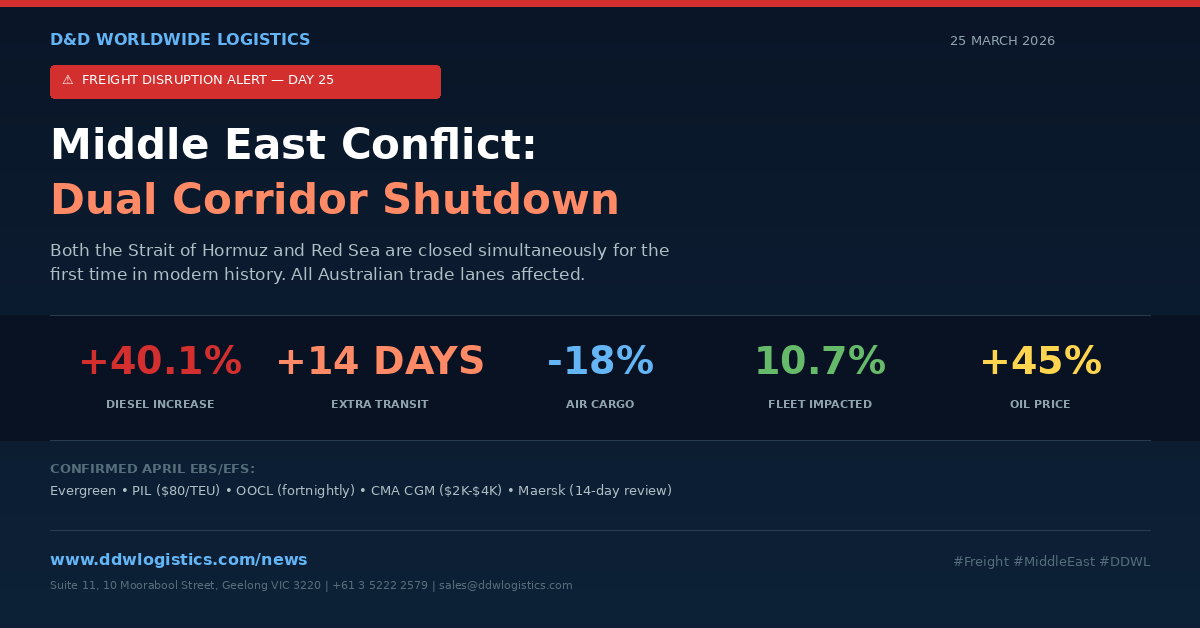
Day 25 | Update 6 | Strait of Hormuz Closed | Red Sea Closed | Dual Corridor Shutdown | FMC Blocks Carrier Surcharge Fast-Track | EBS/EFS April Updates — Evergreen, PIL, OOCL Confirmed | Hapag-Lloyd/Zim $4.2B Merger Pending | Diesel Up +40.1% Across Australia
Situation Summary — 25 March 2026
The Middle East conflict has now entered its fourth week with no ceasefire in sight. For the first time in modern history, both of the Middle East’s key shipping corridors — the Strait of Hormuz and the Red Sea/Suez Canal — are closed simultaneously. This dual closure is unprecedented and is reshaping global freight routing, pricing, and capacity in ways not seen since COVID-19.
Following the US-Israeli strikes on Iranian targets on 28 February 2026 and Iran’s subsequent missile and drone retaliation across the Gulf region, every major ocean carrier has suspended Strait of Hormuz transits. The Red Sea remains effectively closed due to ongoing Houthi attacks. Cape of Good Hope diversions are now standard, adding 10–14 days to transit times on key trade lanes.
Key Developments This Week
1. FMC Blocks Carriers’ Push for Faster Rate Hikes
On 24 March 2026, the US Federal Maritime Commission (FMC) rejected requests from CMA CGM, Hapag-Lloyd, Maersk, and Zim to shorten the standard 30-day notice period for new Middle East conflict-related surcharges. FMC Chair Laura DiBella ruled that the carriers failed to demonstrate “good cause” and set an explicit documentation standard: cost data, duration estimates, and mitigation steps must accompany any future surcharge filings. This means these carriers cannot impose new US-trade surcharges until early April at the earliest.
What this means for Australian shippers: While the FMC ruling directly governs US trades, it signals global regulatory pushback against carrier surcharge practices. India has separately ordered carriers to halt predatory Hormuz pricing. Australian shippers should verify whether surcharges being applied to their shipments comply with contractual terms and whether proper notice was given.
2. Hapag-Lloyd’s $4.2 Billion Zim Acquisition
The pending Hapag-Lloyd acquisition of Zim for $4.2 billion ($35/share) is one of the biggest consolidation moves in container shipping history. If approved, Hapag-Lloyd’s trans-Pacific market share rises from 7% to 12%, creating the world’s fifth-largest carrier with a fleet exceeding 400 vessels and 3 million+ TEU capacity. Regulatory and shareholder approval is expected by late 2026. A carved-out “New Zim” entity backed by Israeli PE firm FIMI will retain 16 vessels serving Israeli trade routes.
What this means for Australian shippers: Fewer independent carriers means less pricing competition on key lanes. Shippers locking in 2026 contracts should factor in the potential for reduced carrier options on trans-Pacific and intra-Asia routes. DDWL’s multi-carrier quoting policy remains critical.
3. Emergency Fuel Surcharge (EFS/EBS) — April Updates
Confirmed carrier updates received by DDWL as of 25 March 2026:
• PIL (Pacific International Lines): EBS of USD $80/TEU for dry cargo confirmed effective 1 April 2026. Monthly review basis.
• OOCL: Updated EBS notice issued. OOCL will review EBS every two weeks and update accordingly. Attachment available on request.
• Hapag-Lloyd: DDWL has requested the April EFS update and destination detention confirmation. Response pending.
• Maersk: Emergency Bunker Surcharge (EBS) in effect globally, reviewed every 14 days. Emergency Freight rates on Gulf-bound cargo. Deadline for cargo options on impacted shipments extended to 25 March 2026.
• CMA CGM: Emergency Conflict Surcharge (ECS): USD $2,000/20’, $3,000/40’, up to $4,000 for special/reefer equipment.
• Evergreen Line: Emergency Bunker Surcharge (EBS) confirmed effective 1 April 2026 (on board date). Destination-specific rates — see table below.
Evergreen Line — EBS April 2026 Rate Table (ex Australia):
• Far East: Dry USD $30/20’, $60/40’ | Reefer USD $45/20’, $90/40’
• Canada: Dry USD $260/20’, $520/40’ | Reefer USD $780/40’
• South Africa: Dry USD $250/20’, $500/40’ | Reefer USD $750/40’
• Mexico/Nicaragua: Dry USD $260/20’, $520/40’ | Reefer USD $780/40’
• Arabian Persian Gulf: Dry USD $200/20’, $400/40’ | Reefer USD $600/40’
• India Sub-Continent: Dry USD $200/20’, $400/40’ | Reefer USD $600/40’
• Red Sea: Dry USD $200/20’, $400/40’ | Reefer USD $600/40’
• Mediterranean Sea: Dry USD $180/20’, $360/40’ | Reefer USD $540/40’
• Europe: Dry & Special USD $180/20’, $360/40’ | Reefer USD $540/40’
• East Africa: Dry USD $250/20’, $500/40’ | Reefer USD $750/40’
• Caribbean Sea: Dry USD $200/20’, $400/40’ | Reefer USD $600/40’
• East Coast South America: Dry USD $200/20’, $400/40’ | Reefer USD $600/40’
• West Coast South America: Dry USD $260/20’, $520/40’ | Reefer USD $780/40’
• USA West Coast: Dry USD $200/20’, $400/40’ | Reefer USD $550/40’
• USA East Coast: Dry USD $200/20’, $400/40’ | Reefer USD $550/40’
Note: Evergreen EBS may be charged separately or added to ocean freight, depending on the destination.
4. Wider Global Impact
• Approximately 10.7% of the global container fleet is directly impacted (Alphaliner data).
• 138 container ships trapped in the Persian Gulf as of early March, accounting for ~470,000 TEUs.
• Oil prices up ~45% and gas up ~55% since late February (UN ESCAP data).
• War risk insurance premiums surging 50–100%; multiple P&I clubs have cancelled Gulf coverage.
• Air cargo capacity down ~18% globally. Emirates, Qatar Airways, and Etihad handle 13% of global air cargo — their effective grounding is severe.
• Gulf refineries offline or at reduced capacity — global fuel redistribution underway.
• US Federal Reserve held interest rates steady on 18 March, citing Middle East uncertainty.
Impact on Australian Business
• Diesel prices: Up +40.1% across Australia since late February (GlobalPetrolPrices/IBTimes data, 22 March 2026). Diesel has climbed to approximately 245.6 cents per litre nationally, with isolated reports of $3/litre in parts of Sydney. Diesel wholesale prices have risen 67% since the first week of March (NRMA data).
• Road transport fuel levy: Increased to approximately 30% effective 16 March 2026, with further increases expected. Recalculates weekly every Monday. ACCC is monitoring petrol and diesel pricing weekly amid conflict.
• Air freight: Spot rates to Europe up 35%+ since 1 March. Australia–Europe belly-hold capacity slashed ~18% with Gulf hub closures.
• Container shipping: Cape of Good Hope routing adds 10–14 days. All carriers are imposing EBS/EFS/War Risk surcharges across all AU/NZ trade lanes.
• Food exporters: Lamb and citrus shipments to the UK face spoilage risk. Some shifting to East-Coast North American gateways.
• Auto sector: Victorian automotive suppliers reporting line-stop risks within 10 days if parts backlogs don’t clear.
• FTA/APSA: Have publicly stated that the situation is having direct and measurable impacts on Australian supply chains.
What DDWL Is Doing
• Monitoring all carrier bulletins, surcharge notices, and airspace updates daily
• Proactively contacting carriers for April EFS/EBS updates and booking availability
• Implementing a minimum 3-carrier quoting policy for all Middle East-exposed trade lanes
• Working alternative routings: Cape of Good Hope, Khor Fakkan/Fujairah overland transfers, Jeddah for Saudi-bound cargo
• Recalculating fuel levies weekly every Monday
• Contacting all clients with affected cargo to develop individual contingency plans
For urgent cargo or to discuss your specific exposure, contact the DDWL team immediately.
D&D Worldwide Logistics Pty Ltd, Suite 11, 10 Moorabool Street, Geelong VIC 3220
P: +61 3 5222 2579 | E: sales@ddwlogistics.com W: www.ddwlogistics.com